Borrowed Wheels, Borrowed Confidence: Inside the Volunteer Bike Libraries Getting People Riding
The village hall smells of Tyre Weld and instant coffee. Along one wall, eight bikes are lined up with a laminated number tag on each set of bars: a Carrera hybrid with new brake blocks, a folding Dahon in a slightly loud shade of green, a step-through that has clearly been resprayed in somebody's garage, and a sturdy-looking tourer with full mudguards and a rack. A woman in her fifties is being handed a helmet, a lock and a map printed out on A4. She hasn't ridden in twenty-two years. She's not buying anything today.
This is a bike library. Not a hire shop, not an app-based share scheme with a fleet of identical frames parked on a pavement, but something much older and much more local: a store of donated, repaired bikes lent out for weeks at a time to people who want to find out whether cycling fits their life before they spend a penny on it.
The clipboard and the container
The models vary enormously. Some operate out of the back of a public library or a community centre, which is where the name comes from. Some are a converted shipping container on a retail park. Some live in a church hall, some at a rail station, some in the corner of a bike kitchen that also runs Dr Bike sessions on the high street. A few are attached to councils' active travel teams; plenty are entirely independent, held together by a rota and a spreadsheet.
What they share is a refusal to make borrowing complicated. You turn up, you show some ID, you might pay a small deposit or a nominal fee, and you leave with a bike that has been checked over by someone who knows what they're looking at. Loans tend to run for a fortnight or a month, sometimes longer, sometimes renewable with a phone call.
And crucially, there is no salesperson involved. Nobody is going to steer you towards the more expensive model, because there isn't one.
What actually gets fixed
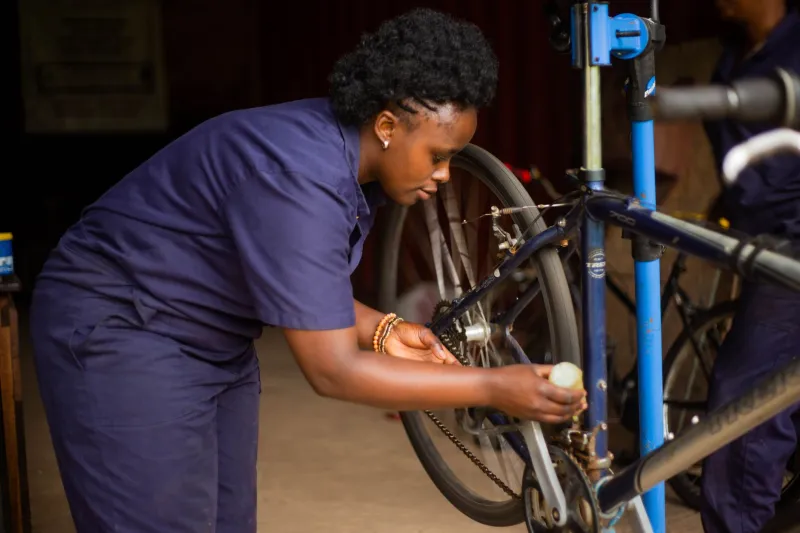
Ask a volunteer mechanic what goes wrong with donated bikes and you get a very consistent list. Brake pads and cables first, always. Then tyres — perished sidewalls on bikes that have hung in garages since the nineties. Then the seized seatpost, the one that needs a week of penetrating oil and a great deal of patience. Bottom brackets on anything that's been left outside. Gears that have been indexed by optimism rather than adjustment.
“Nine times out of ten the frame is fine,” one coordinator told me, wiping her hands on a rag. “It's everything bolted to it that's given up. Which is good news, because frames are the expensive bit.”
The other thing volunteers fix is expectations. A donated bike might be a decade old and worth very little on paper, but once the brakes bite and the gears click through cleanly, it's a perfectly good weekend machine. There's a quiet lesson in that, and most of the people who run these schemes will make the same point: the barrier to a Saturday loop is almost never the quality of the bike.
The cost of not being sure
Here's the arithmetic that stops people. A halfway decent hybrid is a few hundred pounds. Add a lock that isn't an insult to the bike, a helmet, lights, maybe a rack and a set of mudguards, and you're looking at a serious outlay before you've turned a pedal. If you're not certain you'll use it — if you're recovering from an injury, if the kids' weekend clubs eat your Saturdays, if you simply don't know whether you'll enjoy it — that's a lot of money to gamble.
A bike library removes the gamble, and it removes something less obvious too: the feeling of walking into a shop and being the person who doesn't know the vocabulary. There's no lycra required at the village hall. No one is going to raise an eyebrow at your trainers.
A first loop that doesn't feel like a test
The woman with the A4 map is going out on the canal towpath, four miles out, a cup of tea, four miles back. It's flat, it's traffic-free, and if it goes badly she can turn around at any point.
That's the whole design. A borrowed bike isn't an audition. It's a low-stakes way to answer a question — do I want to do this on a Sunday morning? — and the answer is allowed to be no, with the bike handed back and no hard feelings.
How to find one near you
- Ask at your local library or community centre; several host loan schemes and know of others nearby.
- Contact your council's active travel or sustainable transport team, who often fund or partner with loan projects.
- Look up your nearest bike kitchen or Dr Bike session — many lend as well as repair.
- Ask a local Cycling UK group or a Sustrans volunteer ranger; they usually know what's running in the area.
- Check local Facebook groups for 'bike library', 'bike loan' and 'bike recycling' — a surprising number operate quietly with no website at all.
What keeps the doors open
Donations of bikes that are genuinely rideable, storage that doesn't cost the earth, insurance, a mechanic rota, and one person who reliably answers emails. That last one is the real engine. Underneath all of it is a simple, generous idea: a bike that isn't being used should be under somebody, not hanging in a garage.
The green folder goes out on a Thursday, comes back on a Monday, gets a check-over, and goes out again. Somewhere down the line, one of those borrowers will stop being a borrower and start being the person at the village hall with a rag and a set of Allen keys, showing someone else where the brakes are. That's the spoke that turns the wheel.