The Sunday Soundcheck: What Your Bike Is Trying to Tell You Before the Next Ride
There is a moment, usually about ten minutes into a Saturday ride, when a new sound arrives. It might be a tick from the front wheel, a creak under hard pedalling, or a soft rub that comes and goes with the bends. Your first instinct is often to ignore it. Your second is to fear the worst. Neither is especially useful.
Learning to listen to your bike is one of the cheapest skills in cycling. It doesn’t require a workshop stand, a torque wrench or a subscription to a maintenance channel. It requires a bit of patience, a safe patch of pavement and the willingness to investigate before something small becomes a walk home. This is not a route into obsessive fettling. It is a way to ride with more confidence, especially through the wet, gritty months when UK lanes seem to deposit half a field into your drivetrain.
Bikes are supposed to make some noise
A perfectly silent bike is a lovely idea, but it is not the norm for a weekend machine that lives in a shed, commutes through road spray and gets ridden on broken tarmac. Chains talk. Cassettes tick. Cables tap against frames. Disc rotors ring slightly when you spin a wheel. Tyres hum on coarse grit. None of that is a problem in itself.
The useful question is not ‘is my bike making a noise?’ It is ‘what kind of noise is it, when does it happen, and is it changing?’ A steady bit of chain chatter that disappears when you pedal smoothly is very different from a sharp crack that appears only when you push hard uphill. Context is everything.
The harmless stuff: chain chatter, brake rub and cable slap
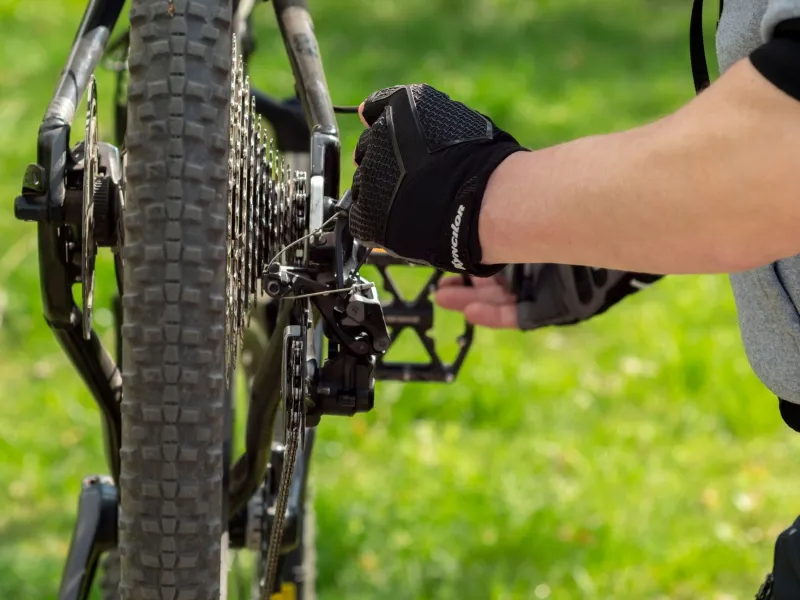
Start with the sounds you can explain easily. Chain chatter is usually a sign of a dry chain, a slightly misaligned gear or a rear mech that is not quite indexing. If it happens only in certain gears, it is worth a small barrel adjuster tweak. If it happens constantly, clean and lubricate the chain before you start worrying about expensive components.
Brake rub can sound dramatic and be utterly trivial. A disc rotor may have a slight wobble. A pad might be a fraction close after a wheel change. A rim brake might be catching because the wheel is not sitting fully in the dropouts. Spin each wheel with the bike lifted and listen. If the rub is constant and the wheel slows quickly, stop and check. If it is a light tick once per revolution, note it and keep an eye on it.
Cable slap is the least sinister noise in cycling. Loose gear or brake outers tapping the frame over rough surfaces can sound like a loose component. A bit of frame protection or a tidy cable tie often solves it. Don’t ignore it forever, but don’t let it ruin a ride either.
The maybe pile: creaks that change with effort
Creaks are trickier because they travel. A sound that seems to come from the bottom bracket may actually be a saddle rail, a seatpost, a pedal thread or a loose cleat. Before you start removing cranks, do the simple checks. Hold the bike still and push down on the saddle. Rock the bike gently side to side. Hold the front brake and push the bars forward. Listen for where the sound changes.
A creak that appears only when you pedal hard often points to the drivetrain or the interface between shoe and pedal. Check cleat bolts. Check pedal threads. Check chainring bolts if you can access them safely. A creak that happens when you stand out of the saddle may be the bars, stem or headset. A creak that follows the road surface may be a bottle cage bolt or a mudguard stay.
The key is to isolate before you lubricate. Spraying oil into every joint can quieten a noise for a week and hide the actual problem. If a creak disappears after a clean and a tighten, good. If it returns quickly, make a note and investigate properly.
The stop-and-look noises
Some sounds deserve an immediate stop. A sharp metallic crack from the front end. A grinding noise from a wheel. A loud pop followed by a wobbly wheel. A brake that suddenly feels spongy or grabs. A tyre that hisses and seals slowly. These are not ‘ride it home and see’ noises.
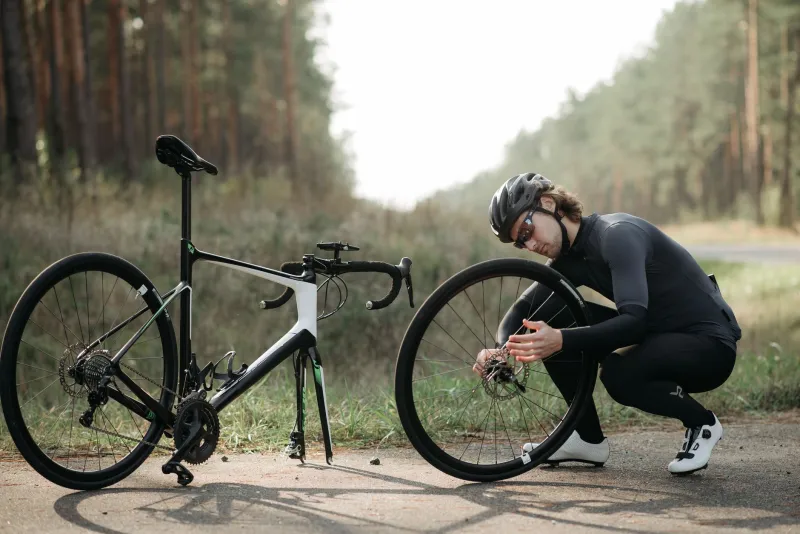
Stop somewhere safe, away from traffic. Check the obvious: quick releases and thru-axles, wheel security, brake pads, tyre damage, loose bottles or bags. If you cannot find a simple cause, do not force the issue. A bike shop is not a failure. It is a sensible next step, especially if the noise involves the fork, headset, cranks or anything you cannot inspect confidently at the roadside.
A two-minute Sunday soundcheck
You don’t need a full service to get to know your bike’s voice. Before your next weekend ride, try this routine in a safe, flat spot.
Lift the front wheel and spin it. Listen for brake rub, bearing grind or a tick from the hub. Do the same for the rear. Bounce the bike gently on its tyres. Rock it side to side while holding the bars. Push down on the saddle. Pedal backwards slowly and listen to the chain. Squeeze both brakes and rock the bike forward and back. Check that bottles, bags and lights are secure.
Then ride a few hundred metres somewhere quiet. Shift through the gears. Brake gently. Stand up and pedal. Sit down and pedal. Listen for changes. If a noise only appears under load, note which gear and which side of the bike it seems to come from. That information is gold when you speak to a mechanic.
When to adjust, when to book it in
Adjust the small stuff yourself if you are comfortable: chain lubrication, gear indexing, a slightly rubbing brake pad, a loose bottle cage bolt. Leave the rest if you are not sure. Bottom brackets, headsets, hubs and suspension forks are not places to learn by overtightening. A good bike shop would rather see you with a specific complaint than a stripped thread and a vague story.
And remember that listening is not the same as worrying. Most noises are mechanical small talk. The skill is in noticing patterns, not in chasing silence. A bike that ticks, hums and clatters a little is often just a bike being used properly. A bike that suddenly sounds different is the one to check.
The payoff is confidence
The real benefit of a listening habit is not a perfectly quiet drivetrain. It is knowing your bike well enough to trust it on a long Sunday loop, a dark commute home or a windy towpath with no phone signal. You learn what normal sounds like, so abnormal stands out. That is worth more than any gadget.
So next time something clicks, don’t turn the music up. Coast for a moment. Listen. Then decide whether to adjust, stop or book it in. Your bike is already talking. You just need to hear it.